How Residential Solar Works: A Simple South African Guide to Panels, Inverters, and Batteries
With Eskom tariffs rising and load-shedding remaining a constant threat to daily life, thousands of South African homeowners are turning to rooftop solar. However, making the switch can feel overwhelming if you do not understand the underlying technology. Terms like “photovoltaic” and “kilowatt-hour” can easily cause confusion.
The good news is that a home solar system in South Africa operates on simple, logical principles. It is a highly efficient loop designed to capture energy from the sun, transform it into usable electricity, and manage your power so you stay up and running when the grid goes down. This absolute beginner’s guide breaks down exactly how residential solar works, focusing on the three core components: panels, inverters, and batteries.
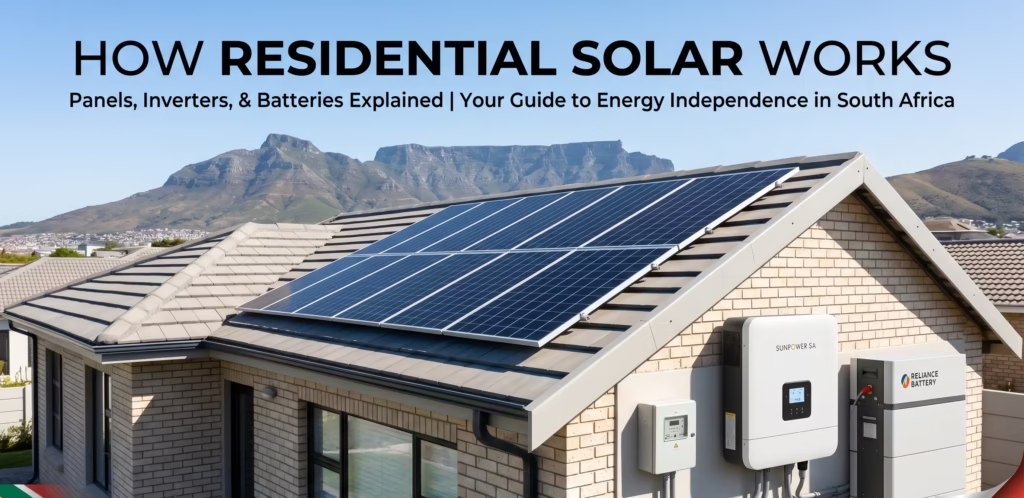
The Three Core Components of a Home Solar System
To understand the system as a whole, you must first understand the individual jobs of its three essential building blocks:
- Solar Panels: The collectors that capture sunlight on your roof.
- The Solar Inverter: The brain of the system that converts and manages the electricity.
- The Solar Battery: The storage unit that saves electricity for nighttime use and power outages.
Step 1: How Solar Panels Convert Sunlight into DC Power
The process begins on your roof. Solar panels are made up of smaller units called photovoltaic (PV) cells, which are manufactured using silicon layers. When sunlight hits these cells, it knocks electrons loose from the silicon atoms. This movement of electrons creates an electrical current.
However, the electricity generated by solar panels is Direct Current (DC) electricity. In a DC current, the electricity flows steadily in a single direction. While this type of power is great for small electronics, it is not the type of electricity used by standard South African household appliances.
It is also important to note that the amount of DC power your panels produce is not fixed. It fluctuates throughout the day based on several variables:
- Solar Irradiance: The actual strength and brightness of the sunlight hitting the cells.
- Temperature: Panels actually become less efficient as they get extremely hot.
- Shading: Shadows from nearby trees, chimneys, or buildings can significantly drop a panel’s output.
- Orientation: The angle and direction your roof faces.
South African Context Note: Because South Africa lies in the Southern Hemisphere, solar panels yield the highest energy output when installed facing true North. While North-East or North-West directions can work if your roof layout demands it, true North remains the gold standard for optimal daily production.
Step 2: How the Solar Inverter Switches DC to AC Power
Because your household appliances run on Alternating Current (AC) electricity—where the current changes direction rapidly—the DC power coming from your roof cannot be plugged directly into your home. This is where the solar inverter comes into play.
The inverter acts as the gateway and the brain of your entire system. It takes the raw, fluctuating DC electricity from the solar panels and converts it into high-quality, “pure sine wave” AC power. Specifically, it outputs clean 230V, 50Hz AC electricity, which perfectly matches both the voltage and frequency standard required by your fridge, television, lights, and borehole pumps.
Beyond this conversion, modern hybrid inverters continuously make intelligent routing decisions:
- If your appliances require power, the inverter routes the converted solar energy directly into your home’s electrical DB board.
- If your home needs more power than the panels are generating, the inverter blends solar power with battery power or the Eskom grid to bridge the gap smoothly.
Step 3: How the Solar Battery Backup Stores Excess Energy
On a bright day in Johannesburg, Durban, or Cape Town, your solar panels will often generate far more electricity than your home actually consumes. Depending on how your system is configured, this excess energy may go unused or, if you have an agreement with your local municipality, it can be exported back to the utility grid via net billing or feed-in tariffs.
However, for most homeowners looking for true energy security, a solar battery backup acts as your personal energy reservoir. In a standard home system setup, the inverter automatically redirects the extra power from the panels to charge your batteries.
This stored energy becomes your ultimate defense mechanism in two specific scenarios:
1. Nighttime Usage
Once the sun sets and your panels stop producing power, the inverter automatically detects the drop in solar generation. Instead of drawing expensive power from the grid, it begins pulling the clean, stored energy out of your batteries to run your home through the evening.
2. Load-Shedding and Grid Outages
When an Eskom power outage or load-shedding block begins, standard grid-tied solar systems must shut down immediately due to a built-in safety mechanism called anti-islanding protection. This protocol prevents your solar system from feeding electricity back into external power lines, ensuring utility workers can safely repair the grid without being electrocuted.
However, if you have a hybrid inverter paired with a battery backup, the system instantly disconnects from the municipal grid and creates a isolated “power island” for your home. Depending on your specific inverter type, the system switches over to battery power almost seamlessly—often in less than 20 milliseconds—keeping your critical lights, security systems, and appliances running safely.
Summary: The Solar Power Step-by-Step Flow
To see how the entire process functions as a unified system, here is the journey of solar energy from the sky to your wall sockets:
| Step | Component | What Happens |
| 1 | Solar Panels | Capture sunlight and generate raw Direct Current (DC) electricity based on sun intensity, temperature, and shading. |
| 2 | Hybrid Inverter | Converts the raw DC power into stable 230V, 50Hz AC power for your appliances. |
| 3 | Home Distribution | The converted AC power runs through your DB board to power your current load. |
| 4 | Battery Bank | Excess, unused solar power is directed to the battery to save for later use or exported to the grid. |
| 5 | Grid/Battery Draw | At night or during load-shedding (utilising anti-islanding safety), the inverter pulls stored energy out of the battery to keep the home running. |
Conclusion: Taking Control of Your Power
Understanding how residential solar works simplifies the transition to clean energy. By using solar panels to generate power, an inverter to transform it, and a battery backup to store it, you can insulate your household from rising electricity costs and unpredictable grid failures. Investing in a tailored home solar system across South Africa is no longer just an eco-friendly choice—it is a practical roadmap to energy independence.