Grid-Tied vs. Off-Grid vs. Hybrid Solar: Which Residential Setup Wins in South Africa?
Investing in a home solar system is one of the most impactful decisions a South African homeowner can make. With electricity tariffs continuing to climb and load-shedding remaining an unpredictable reality, moving toward energy security is no longer a luxury—it is a necessity.
However, when you begin looking for quotes, you will immediately encounter three distinct system architectures: Grid-Tied, Off-Grid, and Sub-Hybrid/Hybrid.
Each system functions differently, handles power outages uniquely, and requires a different level of financial investment. To help you make an informed choice, this guide breaks down the operational differences between these setups and explains why one specific architecture has emerged as a highly practical balance for South African homes.
1. Grid-Tied Solar Systems: The Budget-Friendly Standard
A grid-tied system is the most basic and affordable type of solar installation. It is designed to work in direct partnership with your local municipal or Eskom connection, making it an excellent option for properties looking to lower daytime electricity bills without the immediate cost of energy storage.
How It Works
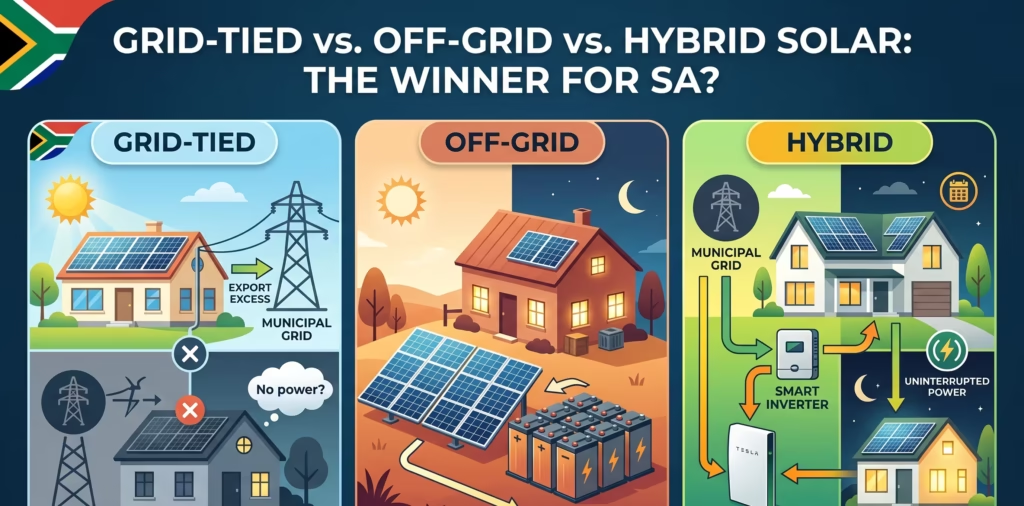
During the day, your rooftop solar panels generate Direct Current (DC) power, and a grid-tied inverter converts it into Alternating Current (AC) power to run your household appliances. If your panels produce more electricity than you need, the excess can often be exported back to the municipal grid via net-billing or Small-Scale Embedded Generation (SSEG) tariffs, depending on your local municipality’s infrastructure. If your home needs more power than the sun provides, the system seamlessly pulls electricity from the grid.
The Catch: What Happens During Load-Shedding?
Many beginners assume that because they have solar panels, their lights will stay on during a blackout. With a grid-tied system, this is not the case.
Due to strict national regulations, grid-tied inverters must feature anti-islanding protection. When the municipal grid goes down, your solar system shuts off instantly within milliseconds. This safety mechanism ensures that your panels do not feed live electricity back into external power lines, which could fatally electrocute utility workers trying to repair the grid. Consequently, a standard grid-tied system offers zero protection against load-shedding.
2. Off-Grid Solar Systems: Total Power Independence
An off-grid system is a complete detachment from Eskom and your local municipality. It is a fully self-sustaining “power island” typically suited for remote areas, farms, or cabins where connecting to the main utility grid is physically impossible or financially unfeasible.
How It Works
Because there is no grid connection to back you up, an off-grid system relies entirely on a solar panel array and a dedicated battery storage bank. Throughout the day, your panels must produce enough electricity to run your home and charge your batteries sufficiently to cover your consumption through the night or consecutive overcast days.
The Trade-Off for Urban Homeowners
While total independence sounds appealing, configuring a true off-grid system for a standard urban residential property can become capital-intensive and logistically demanding:
- Sizing Challenges: To ensure reliability, the system components must be sized to accommodate a property’s maximum load profile and local winter weather patterns.
- Load Management: Running multiple high-surge appliances (like geysers, pool pumps, and stoves) simultaneously requires heavy-duty inverters and substantial battery capacity to manage peak demand safely.
3. Hybrid Solar Systems: The Best of Both Worlds
A hybrid solar system combines the grid connectivity of a grid-tied setup with the energy storage capabilities of an off-grid system. It is specifically engineered to dynamically route power between your panels, batteries, the household load, and the utility grid.
How It Works
A intelligent hybrid inverter acts as the traffic controller for your home’s energy.
- During Peak Production: The system routes solar energy directly to your household appliances to reduce your reliance on grid electricity. Any excess energy generated is directed to top up your lithium-ion battery backup.
- Once the Battery Is Full: If your local municipality supports it, further excess can be fed back into the grid for financial credit.
- During High-Demand Moments: If your household demand exceeds your immediate solar output, a properly configured hybrid system bridges the gap by drawing supplemental power from the grid or battery, helping manage the load without exceeding your inverter’s threshold.
Why Hybrid Solar Is Highly Practical for South African Homes
For many South African homeowners affected by load-shedding, hybrid systems are often the most practical balance between resilience, flexibility, and cost. Here is how this architecture aligns with our energy landscape:
- Near-Seamless Backup Power: When an Eskom blackout or load-shedding window strikes, a hybrid inverter equipped with a functional battery bank isolates your home from the municipal grid. It creates a localized power loop, drawing energy from your battery bank and panels to keep your pre-wired critical circuits running with minimal disruption.
- Daily Financial Optimization: You do not have to wait for a power outage to benefit from your battery. Hybrid systems allow for “load shifting”—storing solar energy during the peak of the day and using that stored battery power during expensive evening tariff windows to offset grid costs.
- Scalable Infrastructure: Unlike off-grid setups, you do not need to buy a massive system all at once. You can install a hybrid inverter and start with a modest panel and battery configuration, utilizing the municipal grid as a reliable safety net while expanding your system over time as your budget allows.
Architecture Quick Comparison Table
| Feature | Grid-Tied | Off-Grid | Hybrid (With Battery) |
| Grid Connection | Connected | Disconnected | Connected |
| Battery Storage | None | Required | Installed for Backup |
| Works During Load-Shedding | No | Yes | Yes (Near-Seamless Transfer) |
| Upfront Cost | Lowest | Dependent on Load Profile | Moderate / Scalable |
| Best Suited For | Properties with daytime-only loads looking to lower utility bills | Remote locations with no utility access | Standard Homes Seeking Outage Protection |
Conclusion: The Verdict
While a grid-tied system keeps your initial capital costs lower, it fails completely when you need it most during load-shedding. On the flip side, going entirely off-grid requires strict lifestyle adjustments, meticulous load management, and significant upfront design consideration.
A hybrid solar system provides the balanced middle ground that many South African homeowners look for. It allows you to maximize your daily solar consumption, reduce your monthly electricity bills, and maintain a reliable line of defense against blackouts—all while keeping the municipal grid available as a backup when the clouds roll in.